Why Steward exists
Most planners assume every day is the same. Steward started on a day that wasn't.
Built for the overloaded
Steward was built for people carrying a lot: work, family, health, and the mental load of keeping it all in the air. Some days there's room for everything. Other days, getting through the essentials is the whole plan. Most tools only understand the first kind of day.
We built the tool we needed. One that asks how today actually feels before deciding what today should hold, and that treats a hard day as information.
Many of the people Steward serves have ADHD, autism, or chronic illness; many others are in a season that simply asks a lot of them. Steward never asks for a diagnosis.
What it does instead is hold the moving parts. It works out what a day can carry and plans inside that. It steps in when the plan outgrows the day, and rebuilds when the day turns. And it keeps a record of how you actually work, so next month starts from something better than memory.
A life operating system for the overloaded, if you want a name for it. Not because it runs your life, but because your head should not have to.
Non-shaming by design
The tone is in the architecture, not the adjectives.
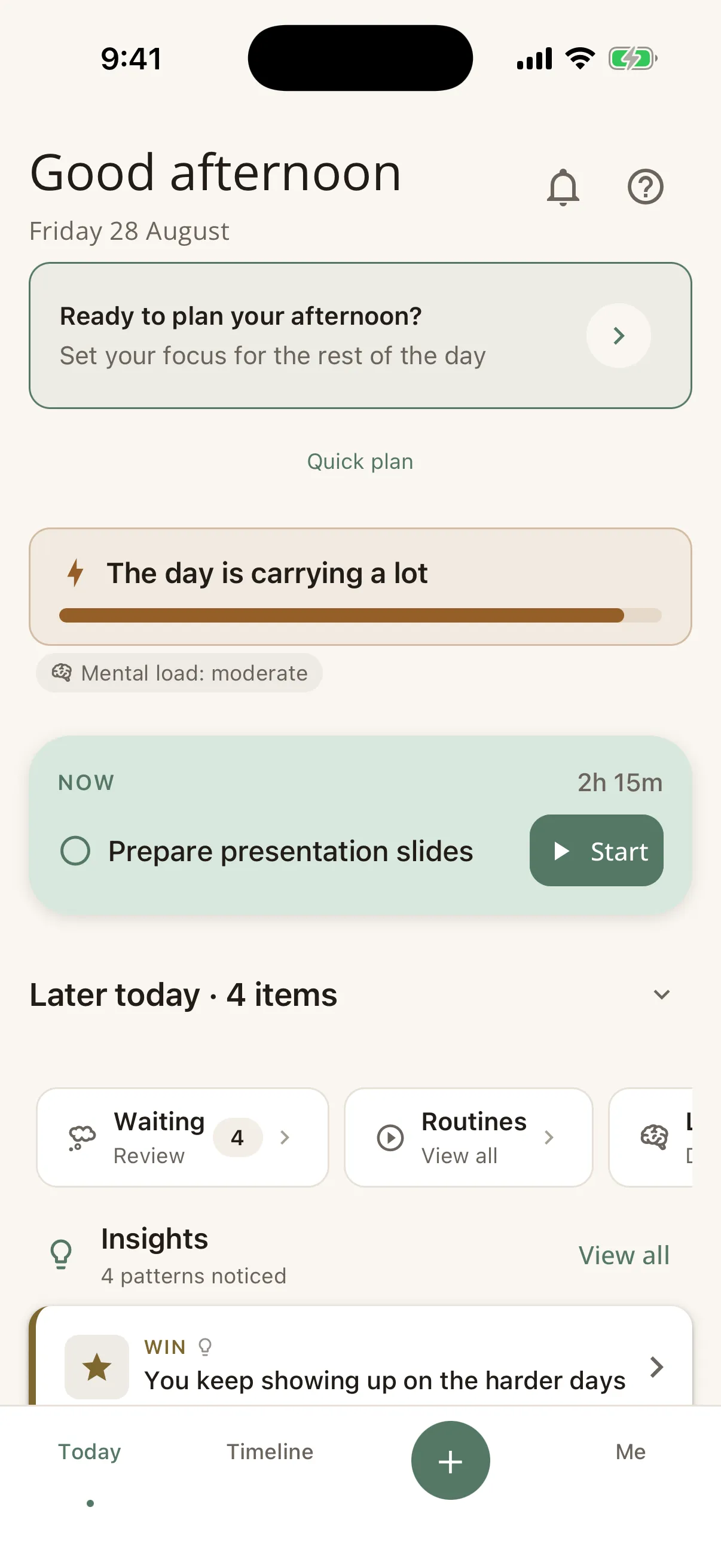
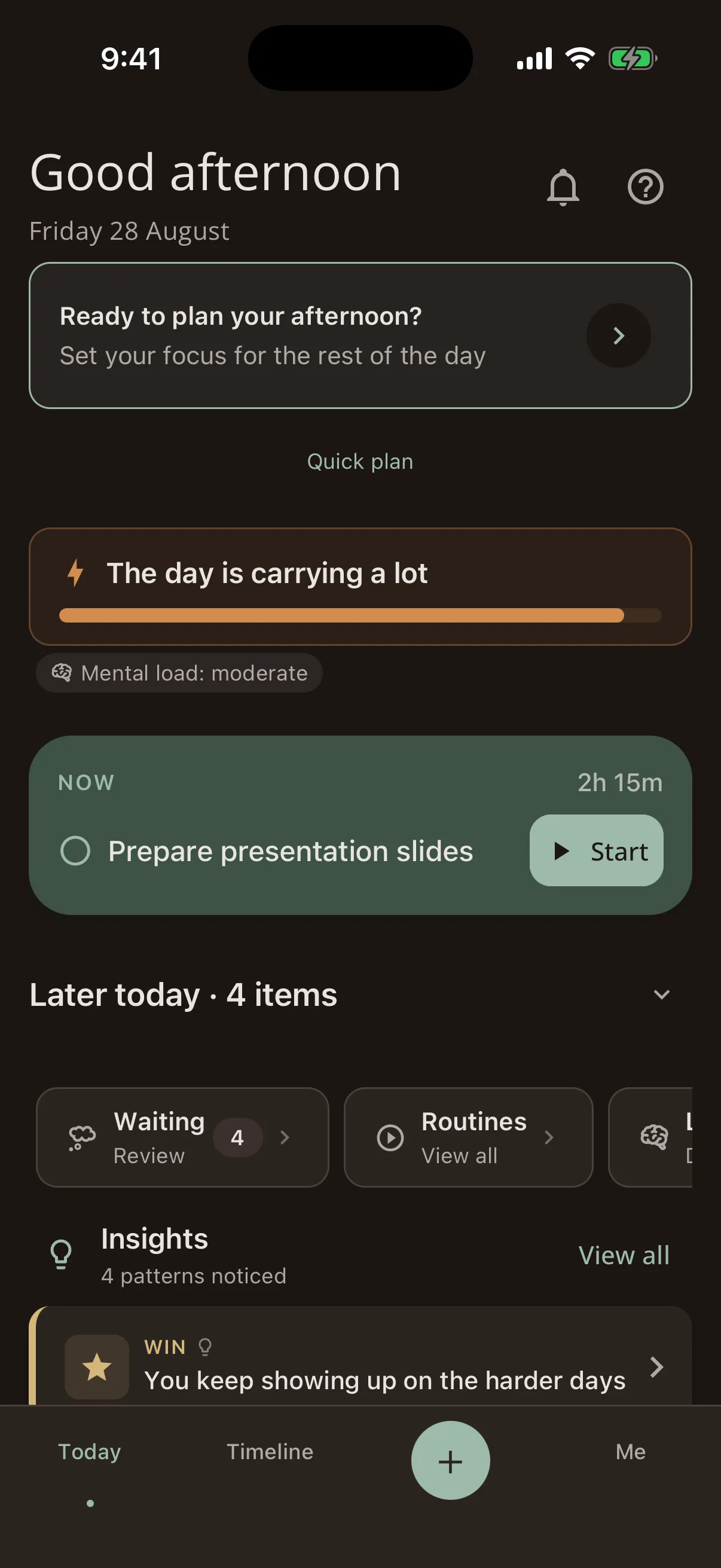
This is structural, not a tone of voice bolted on at the end. Steward’s copy describes the plan, never the person: "The plan is beyond today’s capacity", not "You’ve taken on too much." When everything is done, it says "The rest can wait."
The architecture follows. A heavy day is amber because the palette has no red state to reach for. Unscheduled tasks go to a list called "waiting". The Firewall arrives with choices, and "keep it heavy" is always one of them. Safety features are pinned as free in code, with a test that fails the build if anyone moves one behind a paywall.
What Steward refuses to do
Some features are missing on purpose. Steward will never have:
- Streaks or badges. A chain you're afraid to break is a countdown to feeling worse, not motivation.
- Red alarms. The heaviest day Steward can describe is amber.
- "You’re behind" messaging. Unfinished tasks move to your waiting list and keep their place.
- Scores on your week. Insights say what they found and what you could try. They never grade the week that produced them.
- Pressure to pay. No countdown offers, no "limited time". The paywall lists what’s free first, and safety features are never behind it.
- Selling your data. There’s nothing to sell, because your data stays on your device.
Local-first
There is no server holding your life.
Your plans, notes and check-ins live on your device in an encrypted database (SQLCipher, AES-256). There is no account to create and no server holding your life. Everything works offline, and you can export your data at any time. Exports are free and always will be.
If you turn AI on, you decide what it can see, one category at a time. A fresh install shares four things: the date, your energy, your stress, and whether Safe Mode is on. Task titles, calendar titles, note titles and every section of your Brain Operating Manual stay off until you switch them on. The contents of your notes stay off the list entirely.
You also pick the route. Steward’s relay forwards your request without storing it. With your own API key, requests go straight from your device to the provider.
The core is free, forever.
Capture, planning, the capacity check, the Overwhelm Firewall, Recalibrate and Safe Mode never sit behind a paywall. See pricing.
A note from the founder
Steward is a planning app for overloaded days. I built it because I needed it and couldn't find it.
I've spent the best part of a decade in security consulting. Client work, deadlines, a lot of moving parts. I'm good at building systems, and for years I assumed that meant the problem was me: too many commitments, a plan written for a person with more hours and more energy than the one who actually turned up, and tools that answered a hard day by quietly suggesting I try harder tomorrow.
At some point I stopped believing the tools. Time and energy are finite. A day has a carrying capacity the same way a shelf does, and stacking more on it doesn't change what it can hold. I wanted a planner that started from that fact instead of politely ignoring it.
So that's what Steward does. It looks at what your day is already carrying before it lets you pile on more. It suggests the one thing worth doing now, and it adapts when your energy changes rather than filing the gap under failure. When everything tips over at once, it helps you put things down in a considered way instead of dropping them. There are no streaks to lose and no guilt mechanics anywhere in it. It is built for brains that run hot, mine included.
The other decision came from my day job. I know what happens to data that lives on other people's servers, so your plans don't live on ours. Steward is local-first: your days, tasks and reflections stay on your device, encrypted, backed up only when and where you choose. We couldn't read them if we wanted to, which is the point.
Steward is made by Lamplighter Software Ltd, my one-person company in the UK. It's in closed beta right now, shaped by a small group of testers whose days look like mine. If it sounds like it might fit yours, join the waitlist on the home page and I'll let you know when it's ready. And if you want to reach me about Steward, [email protected] comes straight to me.
Imran
Try it on one of the other days
Join the waitlist and we'll send you an invite when the next batch goes out.
We’ll respect your inbox and only email when there’s something worth sharing.